No posts published in this language yet
Once posts are published, you’ll see them here.
Connectivity is at the core of IoT device development, but building a successful IoT product takes much more than getting a device online.
From early design to manufacturing, every decision affects whether a product can move from prototype to reliable real-world deployment. A connected device should not be treated as a communication module with a housing around it. It should be designed as a complete system.
At the same time, AI, edge computing, and smart consumer products are pushing more everyday devices to become connected. As a result, customers are looking beyond basic connectivity. Reliability, security, and long-term manageability are becoming just as important.
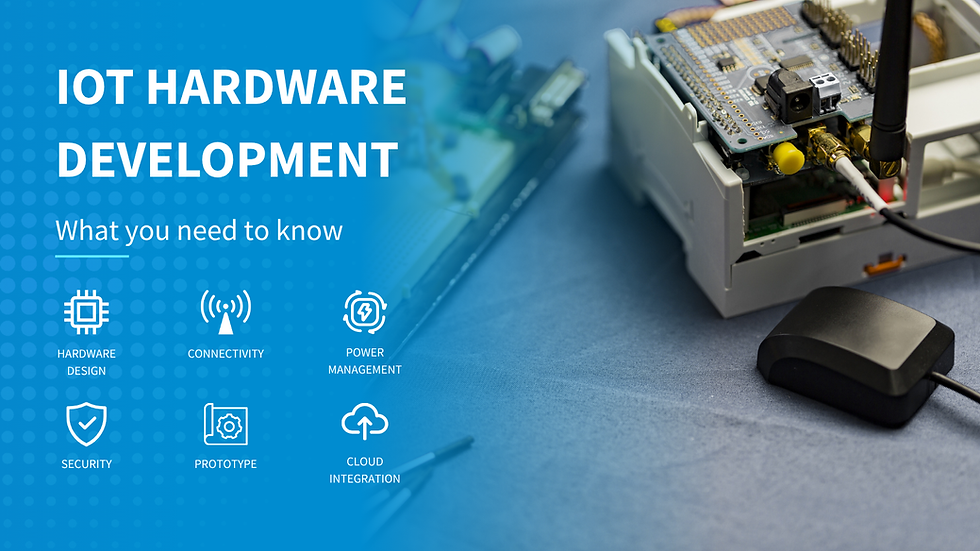
This guide explains what IoT device development involves, where projects often run into trouble, and what it takes to move from concept to a deployable, manufacturable product.
IoT device development is the process of designing and building connected devices that can collect data, process information, and communicate with other devices, systems, or cloud platforms.
A typical IoT device may include sensors, a microprocessor, wireless communication modules, antennas, a power system, firmware, and an enclosure.
But IoT device development is not simply about putting these parts together. The real development process needs to solve a series of practical questions based on the actual application scenario:
How will the device connect?
How often will it send data?
How long does the battery need to last?
Where will it be installed?
How should it behave under weak signal?
Does the device need to be waterproof, dustproof, or impact-resistant?
What certifications will it need?
···
That is why IoT device development is a system-level engineering process.
Every design decision can affect product performance, cost, certification, production efficiency, and long-term reliability. A successful IoT project usually requires collaboration among hardware engineers, firmware engineers, RF engineers, mechanical engineers, project managers, sourcing teams, and manufacturing teams.
IoT devices are used across many industries, but their core value is similar: they turn real-world conditions into usable data.
In asset tracking and logistics, IoT devices help monitor vehicles, containers, tools, and high-value assets. GPS, cellular connectivity, Bluetooth, and sensors can provide location, movement, temperature, and status information.
In smart agriculture and livestock management, connected collars, ear tags, gateways, and environmental sensors help operators monitor animal location, activity, and field conditions.
In industrial IoT, sensor nodes and gateways are used to monitor equipment, production lines, energy usage, vibration, temperature, and machine status. The goal is often to reduce downtime and improve operational visibility.
In security and fleet applications, connected cameras, dashcams, trackers, access control devices, and alarm systems help improve monitoring, response, and asset protection.
In energy and utilities, IoT devices are used for smart meters, battery systems, solar monitoring, power stations, and remote equipment management.
Although the applications differ, the development challenge is often the same: the device must collect the right data, communicate reliably, survive the real environment, and remain practical to deploy and maintain.
A strong IoT project starts with clear requirements. Before any design work begins, the team should define the use case, installation environment, data needs, battery life target, connectivity method, certification market, and expected production volume. If these assumptions keep changing, the hardware usually has to change with them.
Connectivity is one of the earliest decisions, and one of the easiest to get wrong. Cellular, LTE-M, NB-IoT, LoRa, Wi-Fi, BLE, GNSS, and satellite connectivity all serve different purposes. The key is not choosing the most popular option, but the one that fits the actual deployment model.
Product architecture defines how the device works as a system. It sets the relationship between the processor, wireless module, sensors, power system, antenna, firmware, and cloud connection. A clear architecture makes later design work more stable and reduces avoidable rework.
This is where the product starts to take physical form. Schematic design, PCB layout, interfaces, protection circuits, and sensor integration all need to support not only the core function, but also production and long-term reliability. In IoT projects, component choice should also be reviewed from a lifecycle and supply perspective, not just a purchasing one.
Many IoT problems that look like “module problems” are actually antenna or layout problems. Antenna placement, grounding, keep-out area, cable routing, and enclosure material should be considered early. Once the mechanical design is fixed, wireless problems become much harder to solve.
Firmware is what turns hardware into a working product. It controls sensing, communication, power behavior, error handling, reconnection, and updates. For IoT devices, stable firmware matters just as much as feature completeness, especially in products that have to work without direct user access.
The enclosure affects durability, waterproofing, antenna performance, heat, user access, installation, and manufacturability.
For outdoor, vehicle, industrial, or livestock applications, the enclosure must be designed around real use conditions, not only appearance.
A prototype is where the main assumptions are tested for the first time. It helps verify whether the hardware, firmware, wireless performance, power behavior, and mechanical fit are moving in the right direction. But a working prototype should be treated as a checkpoint, not proof that the product is already production-ready.
Wireless products often require regional certifications such as FCC, CE, RoHS, carrier-related testing, or industry-specific approvals.
Certification should be planned early because antenna design, module selection, enclosure materials, labeling, and firmware behavior may affect the result.
Pilot production is where many practical issues finally become visible. It helps validate assembly flow, firmware flashing, test coverage, production consistency, and BOM readiness before full-scale manufacturing begins. For many IoT products, this is the stage where the difference between a working sample and a manufacturable product becomes clear.
In the lab, engineers can reset, recharge, reflash, and debug a device whenever needed. In real deployment, the environment is far less predictable. A device may be installed in the wrong position, placed in poor signal conditions, or used in ways that were never part of the lab setup. This is why IoT testing needs to reflect the real environment, not only ideal bench conditions.
Power estimates often look reasonable during design, but field conditions can change them quickly. Weak signal, slow GPS fix, failed uploads, repeated retries, or poor sleep-mode behavior can all shorten battery life. For battery-powered IoT devices, the real challenge is proving the full system can meet the expected working cycle.
A certified wireless module does not automatically guarantee stable connectivity. Antenna placement, PCB layout, grounding, enclosure material, and installation position can all affect performance. If wireless issues appear late, fixing them may require changes to the antenna, PCB, enclosure, or certification plan.
An IoT device may power on, flash firmware, and upload data once on the production line, but still fail later under weak signal, repeated reconnection, low battery, or real installation conditions. The challenge is to keep testing fast enough for production while still catching the risks that matter after the device leaves the factory.
Many IoT projects do not fail because of one dramatic mistake. They become difficult because a few early decisions create bigger problems later.
A device does not become deployment-ready just because it has a wireless module or a SIM. Real network behavior, signal loss, roaming, recovery logic, and field conditions can all change the result after deployment.
Bench testing is not enough for connected devices. Many issues only appear under weak signal, unstable power, moisture, shock, or other real operating conditions.
Certification is not just a final paperwork step. Module choice, antenna design, and product structure can all affect the approval path, and delays here can push back the whole launch schedule.
An IoT product should not be designed only for the first shipment. Firmware updates, long-term support, component changes, and future product generations should be considered early.
MIOT supports IoT device development from concept to production. We help customers turn product ideas into reliable connected devices through hardware design, RF and antenna engineering, firmware development, prototyping, testing, and manufacturing support. The goal is not only to build a working device, but to make sure it is ready for real-world deployment and scalable production.